In this guide, we’ll explore the most promising Technology & Software Opportunities in 2027, realistic ways to get started, and how small online activities can evolve into long-term digital businesses.

Why Technology & Software Opportunities in 2027 Matter
Technology is no longer limited to technology companies.
Healthcare providers use digital systems to manage patient records. Retailers rely on e-commerce platforms. Financial institutions use artificial intelligence to analyze transactions. Educational organizations depend on software to deliver online learning.
According to the World Economic Forum, digital transformation remains one of the strongest forces driving economic growth and workplace change worldwide.
At the same time, industry research from Gartner continues to highlight increased investment in:
- Artificial Intelligence (AI)
- Cloud Computing
- Cybersecurity
- Business Automation
- Data Analytics
- Software Development
This means the opportunities extend beyond coding. Business owners, marketers, educators, content creators, consultants, and freelancers can all benefit from technology-driven growth.
Setting Realistic Expectations About Online Income
Before discussing future opportunities, it’s important to be realistic.
Many people enter the online world through beginner-friendly methods such as:
- Online surveys
- Micro-task websites
- Freelance platforms
- App testing
- Small content creation projects
- Virtual assistance
These activities can provide valuable experience and help develop digital skills.
However, they typically generate modest income and should be viewed as learning opportunities rather than permanent financial solutions.
Most successful digital entrepreneurs eventually move beyond task-based income and focus on building assets that can continue producing value.
This is where many of the biggest Technology & Software Opportunities in 2027 become relevant.
The Most Promising Technology & Software Opportunities in 2027
1. Artificial Intelligence and Automation
Artificial intelligence has evolved from an emerging technology into a mainstream business tool.
Businesses now use AI to:
- Automate repetitive tasks
- Improve customer support
- Analyze large datasets
- Create content drafts
- Optimize business operations
- Improve decision-making
As adoption increases, demand is growing for people who understand how to implement AI effectively.
Future opportunities may include:
- AI consulting
- Workflow automation services
- AI software development
- Prompt engineering
- Business process optimization
- AI education and training
The opportunity is not simply using AI tools. The real value comes from helping businesses solve practical problems.
Real-World Example
A freelance marketer learns how to automate customer follow-ups using AI tools.
Instead of charging clients for individual tasks, they begin offering monthly automation management services. Over time, this creates recurring revenue and stronger client relationships.

2. Cybersecurity and Digital Privacy
Cybersecurity remains critical as threats continue evolving. Guidance from the Cybersecurity and Infrastructure Security Agency (CISA) emphasizes the importance of securing business systems, employee devices, and online services.
Cybersecurity remains one of the fastest-growing technology sectors.
As organizations become increasingly dependent on digital systems, protecting data becomes more important.
Businesses need help securing:
- Customer information
- Cloud infrastructure
- Employee devices
- Remote work environments
- Online transactions
This creates opportunities for cybersecurity professionals, consultants, educators, and software developers.
Understanding digital privacy tools is becoming increasingly valuable. Readers interested in privacy technologies may also find our guide on VPN vs Proxy Server: What’s the Actual Difference and When Does Each Protect You? useful for understanding online security concepts.
3. Cloud Computing Services
Major cloud providers such as Amazon Web Services, Microsoft Azure, and Google Cloud continue expanding their infrastructure to meet growing business demand.
Cloud computing has fundamentally changed how businesses operate.
Instead of maintaining expensive physical servers, organizations increasingly use cloud platforms to host applications and manage data.
By 2027, cloud adoption is expected to continue growing across industries.
Potential opportunities include:
- Cloud consulting
- Cloud migration services
- Infrastructure management
- Cloud security solutions
- Performance optimization
Businesses often need guidance to use cloud resources efficiently, creating demand for knowledgeable professionals.
4. Software-as-a-Service (SaaS)
One of the most scalable Technology & Software Opportunities in 2027 remains SaaS.
SaaS businesses generate recurring revenue by providing ongoing software subscriptions.
Examples include:
- Project management software
- Accounting tools
- Marketing automation platforms
- Customer relationship management systems
- Industry-specific business solutions
Many successful SaaS products solve small but important problems for specific audiences.
This demonstrates that innovation does not always require creating the next global technology giant.
5. Data Analytics and Business Intelligence
Organizations generate massive amounts of data every day.
The challenge is converting that information into useful insights.
Businesses increasingly rely on data professionals to:
- Analyze trends
- Predict customer behavior
- Improve marketing performance
- Optimize operations
- Support strategic decisions
Professionals who understand data analysis tools are likely to remain valuable across many industries.

How Small Opportunities Lead to Bigger Systems
One mistake many beginners make is treating small online jobs as the final goal.
In reality, these opportunities often serve as stepping stones.
Consider the following examples:
- A freelance writer launches a niche blog.
- A video editor creates a YouTube channel.
- A web developer builds a SaaS product.
- A social media manager starts a digital agency.
- An educator launches an online course platform.
Each began with a service or skill but eventually evolved into a digital asset.
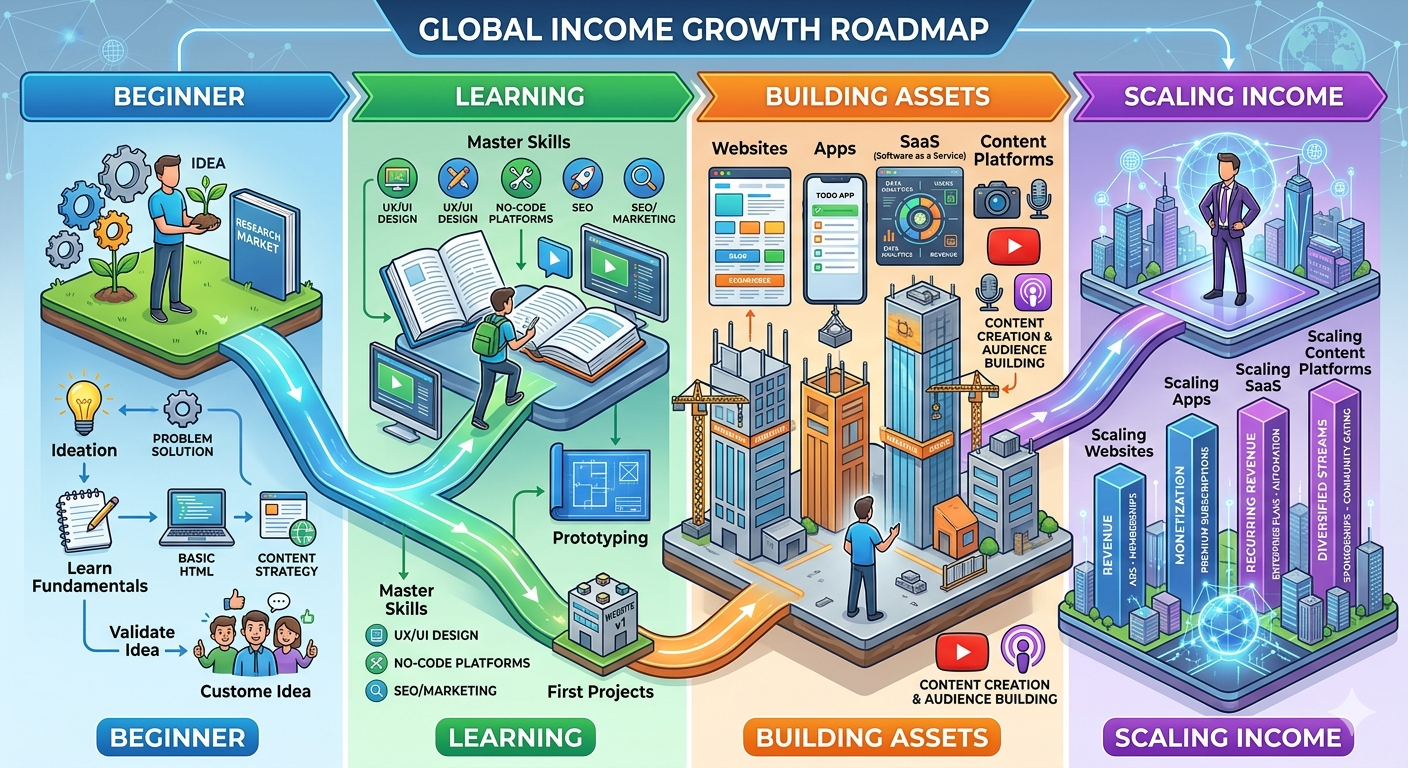
The Growth Path: Beginner → Learning → Building Assets → Scaling Income
Most sustainable online success follows a similar progression.
Stage 1: Beginner
This stage focuses on learning.
People typically:
- Take courses
- Practice skills
- Complete small projects
- Gain experience
- Build confidence
Stage 2: Skill Development
As experience grows, individuals often specialize in areas such as:
- AI
- Cybersecurity
- Cloud Computing
- Software Development
- Content Creation
- Digital Marketing
Stage 3: Building Digital Assets
This is where long-term opportunities begin to emerge.
Examples include:
- Websites and blogs
- YouTube channels
- Mobile applications
- Online communities
- Software products
- Educational platforms
Unlike client work, these assets can continue creating value long after the initial effort.
Stage 4: Scaling Income
Once an asset gains users, customers, or traffic, additional revenue opportunities become available.
Examples include:
- Advertising
- Affiliate partnerships
- Subscriptions
- Sponsorships
- Digital product sales
- Consulting services
How Valspill Team Supports Long-Term Digital Growth
Building successful digital assets often requires technical expertise, strategic planning, and consistent execution.
Many entrepreneurs understand the opportunity but struggle with implementation.
Valspill Team focuses on helping businesses, creators, and entrepreneurs develop websites, software platforms, content systems, and scalable digital assets designed for sustainable growth and revenue generation.
The emphasis is on building long-term systems rather than chasing short-term trends.
Skills That Will Remain Valuable Beyond 2027
Technology evolves rapidly, but some skills consistently remain valuable.
These include:
- Problem-solving
- Communication
- Software development
- Data analysis
- Digital marketing
- Cybersecurity awareness
- User experience design
- Project management
- Business strategy
Professionals who combine technical expertise with business understanding often create the greatest value.
Potential Challenges to Consider
While the future looks promising, technology opportunities are not without challenges.
Common obstacles include:
- Rapid technological change
- Increasing competition
- Continuous learning requirements
- Market saturation in some niches
- Long development timelines
Understanding these realities helps maintain realistic expectations and encourages better planning.
The Future Outlook for Technology & Software Opportunities in 2027
The future of technology is likely to be defined by automation, intelligence, connectivity, and digital ownership.
Artificial intelligence will continue influencing business operations. Cloud infrastructure will remain essential. Cybersecurity will become increasingly important. Software solutions will continue expanding into new industries.
For individuals, the greatest opportunities may not come from simply using technology but from creating systems, products, and assets that provide value to others.
Final Thoughts
Technology & Software Opportunities in 2027 offer significant potential for people willing to learn, adapt, and think long term.
While beginner online earning methods can provide valuable experience, sustainable growth often comes from building digital assets such as websites, blogs, YouTube channels, software products, and mobile applications.
The journey usually follows a clear progression:
Beginner → Learning → Building Assets → Scaling Income
Those who focus on solving real problems, developing valuable skills, and creating assets they control are often best positioned to benefit from future technology trends.
If you’re exploring technology opportunities, start by learning, experiment with small projects, and gradually work toward building assets that can continue generating value over time.
The future belongs to those who build, adapt, and continue learning.
Frequently Asked Questions (FAQ)
What are the biggest Technology & Software Opportunities in 2027?
Artificial intelligence, cybersecurity, cloud computing, SaaS businesses, automation, and data analytics are expected to remain among the strongest growth areas.
Can beginners benefit from Technology & Software Opportunities in 2027?
Yes. Many people begin with learning platforms, freelance projects, and small online opportunities before progressing to larger ventures.
Do I need programming skills to succeed in technology?
No. Opportunities also exist in marketing, content creation, consulting, project management, sales, design, and education.
What is the most scalable digital asset?
Websites, SaaS products, YouTube channels, mobile applications, and educational platforms are among the most scalable digital assets available.
How long does it take to build sustainable online income?
It varies significantly. Most successful digital assets require consistent effort over months or years rather than delivering immediate results.
Why is asset ownership important?
Owned assets can continue generating value and revenue over time, making them more sustainable than relying solely on task-based income.